

In healthcare environments, time isn’t just money; it’s patient care. Every minute nurses, clinicians, and support staff spend searching for supplies is time taken away from patients, workflows, and critical tasks. In hospitals and healthcare facilities where speed, accuracy, and compliance matter, inefficient storage can quietly create major operational challenges.
Whether it’s a central supply room, clean utility closet, sterile processing department, or pharmacy backroom, reducing the time staff spend locating supplies can dramatically improve efficiency, reduce burnout, and support better patient outcomes.
One of the most effective ways hospitals and healthcare facilities are addressing this issue is through mobile racking systems. By transforming traditional static shelving into high-density, organized storage, mobile racking reduces travel time, improves visibility, and ensures staff can quickly access the supplies they need, when they need them.
In this blog, we’ll explore how mobile racking saves time in healthcare settings and answer common questions about mobile storage systems for hospitals.
Mobile racking is a storage system where shelving or racks are mounted on mobile carriages that move along floor-mounted or embedded rails. Instead of multiple fixed aisles, mobile systems consolidate storage into one or two access aisles that open as needed.
For healthcare facilities, this means:
Mobile racking is commonly used in hospitals for medical supplies, PPE, linens, sterile instruments, pharmaceuticals, patient records, and more.
In hospitals, staff often travel long distances between patient rooms, supply closets, and storage areas. Traditional static shelving forces staff to walk up and down multiple aisles to locate items, especially when storage rooms are cramped or overfilled.
Mobile racking eliminates unnecessary aisles, allowing staff to open only the aisle they need. This significantly reduces walking time, helping nurses and support staff spend more time on patient care instead of searching for supplies.
Even small time savings per trip can add up to hours saved per shift across an entire unit.

Disorganized supply rooms lead to missed items, overstocking, expired products, and last-minute shortages. Mobile racking encourages structured organization with clearly defined sections for different supply categories.
When supplies are easy to see and consistently stored:
This is especially critical in healthcare settings where missing or expired supplies can delay care or create compliance risks.
High-traffic areas such as emergency departments, operating rooms, and central supply rooms require fast, frequent picking and restocking. Mobile racking shortens the time it takes to retrieve commonly used items by keeping everything accessible and logically organized.
For departments managing high volumes of supplies, this leads to:
When supplies move faster, patient care moves faster.
Hospitals operate 24/7 with rotating shifts, temporary staff, and multiple departments accessing shared storage spaces. Without a standardized system, supplies end up misplaced, duplicated, or hard to locate.
Mobile racking supports consistent layouts and labeling, so every staff member knows exactly where items belong, regardless of shift or department. This consistency dramatically reduces search time and minimizes frustration for clinical and non-clinical staff alike.
Mobile racking is widely used across healthcare environments, including:
Any healthcare setting struggling with limited space, cluttered storage, or wasted staff time can benefit from mobile racking.
When properly designed and implemented, mobile racking can help hospitals:
These improvements lead to measurable operational efficiencies and a strong return on investment, especially in labor-intensive healthcare environments.
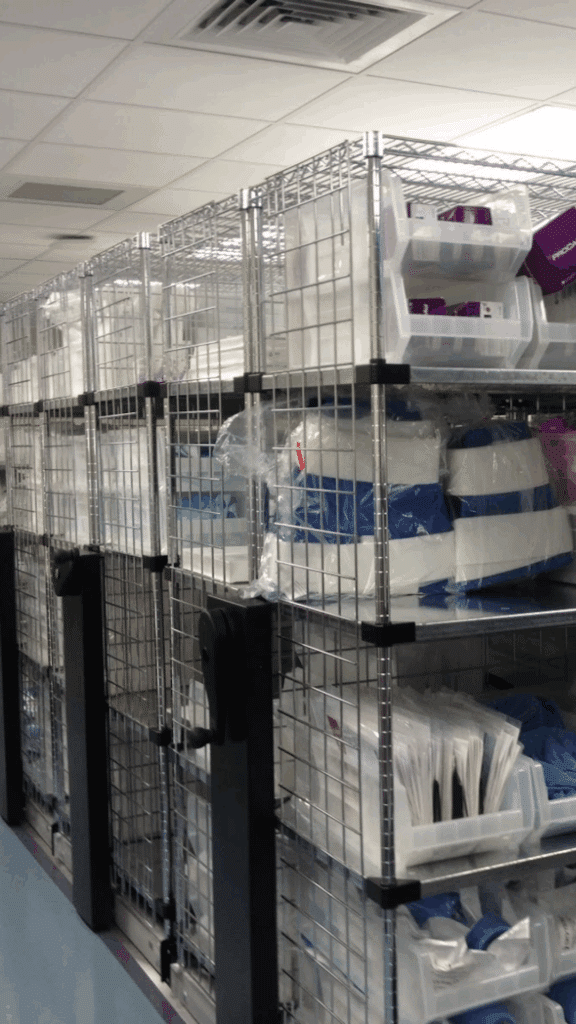
When properly designed and implemented, mobile racking can help hospitals:
These improvements lead to measurable operational efficiencies and a strong return on investment, especially in labor-intensive healthcare environments.
Q1: What is mobile racking and how does it work in hospitals?
A: Mobile racking uses shelving mounted on movable carriages that slide open to create access aisles. In hospitals, this allows more supplies to be stored in less space while keeping items easily accessible.
Q2: Can mobile racking really save time for healthcare staff?
A: Yes. By reducing walking distance, improving visibility, and standardizing organization, mobile racking significantly cuts the time nurses and staff spend searching for supplies.
Q3: Is mobile racking suitable for small hospital storage rooms?
A: Absolutely. Mobile racking is especially effective in tight spaces, making it ideal for crowded supply closets and utility rooms.
Q4: Is mobile racking safe for healthcare environments?
A: Yes. Healthcare-grade mobile systems are designed with safety features such as aisle locks, smooth movement, and compliance with facility requirements.
Q5: How do we choose the right mobile racking system for our hospital?
A: Consider supply types, access frequency, weight requirements, infection control needs, and workflow patterns. A storage specialist can help design a system tailored to your facility.
In healthcare, efficiency directly impacts patient care. Mobile racking is more than a space-saving solution. It’s a strategic tool that helps hospitals reduce wasted time, support staff workflows, and keep critical supplies within easy reach.
At Pipp Mobile, we design and deliver mobile storage solutions built for demanding healthcare environments. From hospital supply rooms to sterile processing areas, our systems help healthcare teams spend less time searching and more time caring for patients.
Explore our healthcare storage solutions and discover how mobile racking can transform your facility.

John Ritter is Vice President of Sales at Pipp Mobile with more than 25 years of experience in the storage fixtures industry. He specializes in developing practical, space-saving storage solutions for specialty retail, indoor cultivation, healthcare, automotive, hospitality, and material handling applications. John works closely with customers to understand their needs and guide projects from initial design through installation. He believes exceptional customer service is at the heart of a successful sales process and takes a hands-on approach to building lasting customer relationships. At Pipp Mobile, John also helps identify opportunities to improve and expand product solutions based on customer feedback and changing industry needs.
budgeting checkout lines efficiency employee management Hanger Management holiday season Hospitality inventory processing inventory transportation solutions MPOS Office Storage Retail retail operations retail solutions retail store curbside pickup return management storage solutions transport solutions visual merchandising


