Walk into a retail backroom during a busy restocking period, and there is usually a lot happening at once.
New inventory is being received. Boxes are being sorted. Associates are pulling merchandise for the sales floor. Carts are moving through already-tight aisles. And somewhere along the way, products are being unloaded, reorganized, and loaded again before they ever reach the shelf. It is easy to assume faster restocking comes down to moving faster.
But often, the bigger issue is the process between storage and the sales floor. The good news? The right carts, transporters, and rolling racks can help retailers simplify inventory movement, reduce unnecessary handling, and make each trip out of the backroom more productive.
Every extra touch adds time. If an associate has to pull merchandise from storage, move it to a staging area, find an available cart, reorganize the load, and then make multiple trips to the sales floor, a simple restocking task becomes a much longer process. Add a crowded retail stockroom into the mix, and movement becomes even harder.
Common slowdowns include:
None of these problems necessarily mean the backroom needs to get bigger. Often, the existing space and workflow simply need to work better together.
A cart is not just a way to move merchandise from Point A to Point B. The right cart can become part of the entire replenishment process. Different merchandise creates different challenges. Hanging apparel does not move the same way as boxed inventory. Small items have different requirements than bulky merchandise. That is why relying on one general-purpose cart for every task can create unnecessary work. Pipp Mobile and IRSG offer carts, transporters, and rolling racks designed around different retail workflows, allowing stores to match the equipment to the merchandise being moved. The goal is not to add more equipment. It is to make sure the equipment you already use supports the work associates need to do.
Think about one box of merchandise arriving in the backroom. How many times does someone touch it before the product reaches the shelf?
If merchandise is unloaded, staged, moved, sorted, loaded onto another cart, and moved again, every handoff adds labor. A better approach is to organize products earlier in the process.
Merchandise can be grouped by:
Then, associates can load once and move the merchandise closer to its final destination.
The result: fewer transfers, fewer trips, and less time spent reorganizing product between the backroom and sales floor.
Backroom floor space disappears quickly when deliveries arrive. When products cannot immediately go into storage, they often end up staged on pallets, tables, or whatever open floor space is available. That creates another problem: everything eventually has to move again. Mobile equipment gives retailers more flexibility.
For example, The Bulk Nesting Transporter can help associates transport boxed, folded, or bulk merchandise while keeping product contained and organized during the move. It also has a hanging goods feature that can be added on.
Instead of creating a temporary pile that needs to be sorted later, merchandise can be organized with its next step in mind. Here’s what that looks like in practice:
Receive → organize → move → stock.
Fewer stops in between can mean a much smoother replenishment process.
Adding more storage or equipment does not automatically create a better backroom. Sometimes, it does the opposite. A cart parked in the wrong location can block access to shelving. Oversized equipment can make narrow aisles harder to navigate. Floor staging can create bottlenecks between receiving, storage, and the sales floor.
That is why equipment selection should be part of the overall retail backroom storage strategy, not treated as an afterthought. Pipp Mobile and IRSG combine mobile shelving, rolling racks, sorting carts, and other material-handling solutions to support both storage and inventory movement.
When evaluating a cart or transporter, ask:
The best cart is not necessarily the one that holds the most. It is the one that fits the workflow.
Fast restocking starts before the cart moves. If inventory is difficult to find or retrieve from storage, the transportation portion of the process can only do so much. A well-organized stockroom should make it easy to locate merchandise, pull it, load it, and move it out.
That may mean improving product organization. It may mean reconsidering where high-turn inventory is stored. In tighter backrooms, it may also mean using mobile shelving to increase storage density without expanding the physical footprint.
The most effective backrooms treat storage and transportation as one connected workflow. Inventory should not just fit. It should be easy to move.
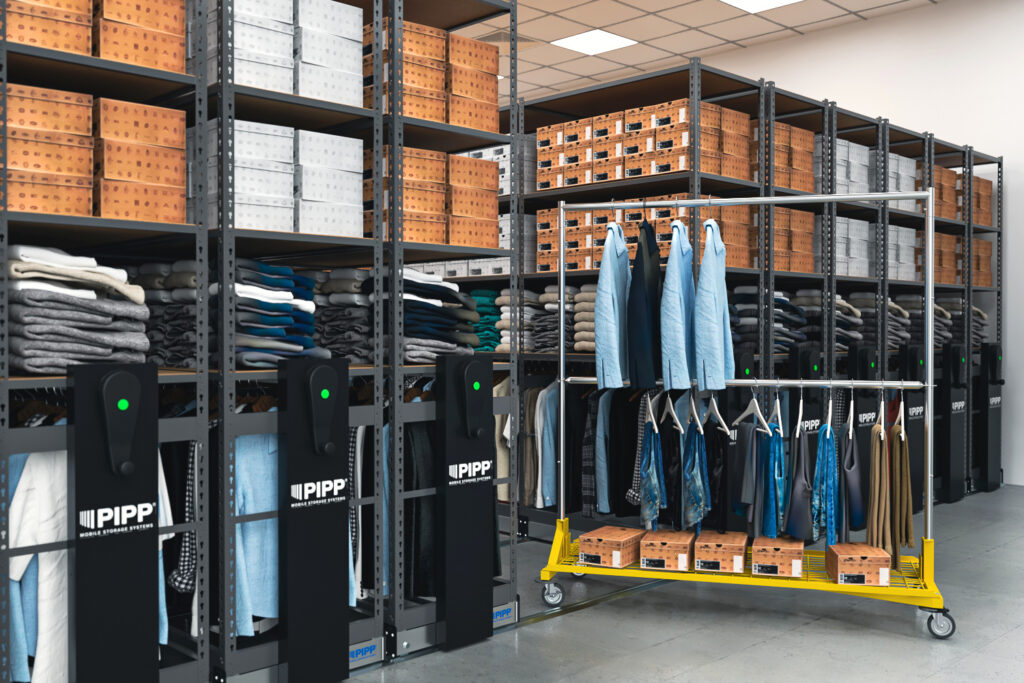
Retailers do not always need more backroom space to improve restocking. Sometimes, the bigger opportunity is making the existing space and workflow work harder. One organized cart is usually more useful than several partially planned trips. Before merchandise leaves the backroom, associates should be able to quickly answer:
What is on the cart? Where is it going? What gets stocked first?
Better organization, accessible storage, and purpose-built transport equipment can help:
This becomes especially important during high-volume deliveries, seasonal resets, and peak shopping periods. The goal is simple: make every square foot and every trip count.
Your associates are already moving quickly. The question is whether the backroom and equipment are helping them. Pipp Mobile and IRSG offer carts, transporters, rolling racks, and storage solutions designed to keep inventory organized and moving from receiving to storage to the sales floor.
Ready to make every restocking trip count?
Explore Carts, Transporters & Rolling Racks
Start by looking for unnecessary steps between storage and the sales floor. Better inventory organization, accessible storage, and carts designed for specific merchandise can reduce searching, rehandling, and repeated trips.
It depends on what the store is moving. Boxed or folded products, hanging garments, bulk merchandise, and smaller replenishment items may each benefit from different carts, transporters, or rolling racks.
Carts can provide mobile staging space and allow merchandise to be organized by department, aisle, or replenishment route before it reaches the sales floor. This can reduce floor staging and make restocking more predictable.
They can be part of the solution. Equipment that fits the available aisles, stores efficiently, and keeps merchandise contained can reduce clutter. Pairing the right transport equipment with high-density storage can help retailers make better use of their existing footprint.
Look beyond capacity. Consider merchandise type, aisle width, maneuverability, loading and unloading, storage when the cart is not in use, and how the cart fits into the store’s overall replenishment process.