Walk into the backroom of a big box store during a truck delivery, and you’ll see it: pallets with boxes stacked three and four levels high in the aisle, associates weaving carts around bottlenecks, and a stockroom that somehow feels both overflowing and disorganized at the same time.
If this sounds familiar, you’re not alone, and you’re definitely not doing anything “wrong.” Big box backrooms were built for a different era of retail, and the volume, SKU count, and delivery cadence they handle today would overwhelm almost any layout that wasn’t designed for it.
The good news? The stores that have cut their restocking time in half didn’t do it by hiring more people or working faster under pressure. They did it by rethinking how product moves from the truck to the shelf, and a lot of that comes down to smarter storage and transport equipment in the backroom itself.
Retailers operating in a big box format face a unique set of backroom challenges that smaller stores simply don’t deal with:
Individually, none of these is a dealbreaker. Together, they create the kind of backroom chaos where a restock that should take 20 minutes stretches into an hour, not because the team isn’t working hard, but because the space and equipment aren’t set up to support the pace the front of the store demands.
The stores that have made real gains in restocking speed focused on three things: reclaiming space, reducing walking and searching time, and giving teams the right carts and transport tools for the job. Here’s what that looks like in practice.
Traditional static shelving requires a fixed aisle in front of every row, which means a huge percentage of backroom square footage is dedicated to walkways instead of storage. Mobile shelving systems eliminate that wasted space by mounting shelving on carriages that glide along tracks, opening only the aisle you need at that moment.
That single change can increase usable storage capacity by up to 80%. Which means more product staged and organized, less overflow stacked in the walkways, and a lot less time spent hunting for where something got shoved during a busy delivery day. We’ve broken down exactly how this works in Your Backroom Is Wasting Space – Here’s How to Fix It.
Big box stores are especially well positioned to take advantage of this kind of space since most already have pallet racking installed in the backroom or warehouse. But the zone beneath the first beam level of that racking is often underutilized, inconsistent at best, and at worst turned into temporary overflow space, disorganized pick zones, or empty clearance nobody’s accounted for. That’s exactly the space an under-rack storage system is built to reclaim. It’s engineered to integrate inside standard pallet rack widths without requiring a full warehouse redesign, so stores can add it as an upgrade rather than tearing out racking they’ve already paid for and installed.
Because it slots underneath existing racks, it also scales on your terms, a few racks at a time, with a quick, low-disruption installation. That makes it a much lower-friction path to more storage than a full mobile shelving retrofit or facility expansion.
This is where a lot of big box backrooms lose the most time. If associates are relying on general-purpose carts that aren’t built for the product mix. Apparel on hangers, boxed electronics, oversized hardware- every trip from the stockroom to the sales floor takes longer than it should.
Purpose-built carts, transporters, and rolling racks, including our IRSG line, are designed to nest together when not in use (saving even more backroom space) and to carry more product per trip. Fewer trips, less handling, faster restocks.
A one-size-fits-all shelving approach rarely works in a big box environment. Apparel needs hanger management that keeps garments organized and wrinkle-free without eating up floor space. Small parts and accessories benefit from drawers and cabinets that keep SKUs visible and easy to grab. High-value or regulated items need secured storage that still allows for quick access. When each category has a system built around how it actually moves, restocking stops being a guessing game.
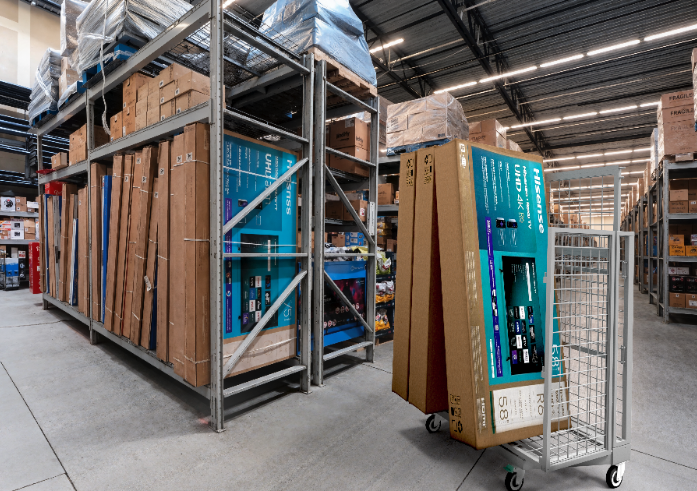
None of this is about pointing out what’s broken. Big box teams are managing an enormous amount of volume, and the chaos isn’t a people problem; it’s a design problem. That’s exactly why we work directly with retail operations teams to run a space capacity analysis, map out how product actually flows through the backroom, and design a custom system around it. You can see this play out in real stores in Transforming Overcrowded Retail Backrooms.
If your backroom feels like it’s fighting you every restock cycle, that’s usually a sign the space just hasn’t caught up to the volume you’re running. A layout and equipment refresh, not more hours or more hands, is usually what closes the gap.
Ready to see what a faster backroom could look like for your store? Get a free quote, and our team will help you design a system built around how your store actually operates.
How can big box stores reduce restocking time?
The fastest wins come from reclaiming wasted aisle space with mobile shelving, using purpose-built carts and transporters instead of general-purpose ones, and organizing product by category (apparel, hardware, electronics) so associates spend less time searching and more time restocking.
What is mobile shelving and how does it help retail backrooms?
Mobile shelving is a storage system where shelving units sit on rolling carriages instead of being fixed in place, so only one aisle needs to be open at a time. This can increase usable storage capacity by up to 80% compared to traditional static shelving, giving stockrooms far more room for organized, accessible inventory.
What are IRSG carts used for in retail stockrooms?
IRSG carts and transporters are designed specifically for moving retail inventory efficiently between the backroom and sales floor. They’re built to carry more product per trip and many models nest together when not in use, saving additional backroom floor space.
Why do big box stores like Walmart and Home Depot have backroom space issues?
High SKU counts, large bulk deliveries, oversized items, and heavy daily foot traffic put more strain on backroom space than most storage layouts were originally designed to handle. Without a system built for that volume, product overflow and disorganization are common, even in well-run stores.
How much can a backroom redesign actually save in restocking time?
Results vary by store, but retailers who combine mobile shelving with category-specific storage and the right transport carts commonly report cutting restocking time significantly, in many cases by half, by reducing walking distance, search time, and the number of trips needed per restock.
Do backroom storage systems need to be custom-designed for each store?
Yes, generally. Backroom layouts, SKU mixes, and delivery volumes differ significantly by store format and category. A space capacity analysis helps map actual product flow so the storage and cart system fits how that specific store operates, rather than forcing a generic layout onto a unique space.